Best Filming Locations in Hong Kong for Commercials and TV

Hong Kong's government location library lists more than 1,400 catalogued filming locations inside a territory you can cross in about an hour. That density is why filming in Hong Kong keeps landing on shortlists for brands and networks working across the region. It's also why schedules fall apart. Your hero shot might sit on government land needing departmental sign-off, while the street outside it needs no permit at all.
Here's what's worth shooting right now, and what each location actually costs you in lead time.

First, the permit reality nobody explains properly
There is no general-purpose filming permit in Hong Kong. The Film Promotion and Facilitation Section (formerly the Film Services Office, now under the Cultural and Creative Industries Development Agency) confirms that no permit is required for filming in public areas on a non-exclusive basis. You're encouraged to notify the Police Public Relations Wing, and that notification is free.
Everything else runs on its own clock. We put the published timelines side by side, because no location guide seems to:
What you want to shoot | Who signs off | Lead time |
Public street, non-exclusive use | Nobody. Notify Police PRW | Days |
Private building, mall, hotel, office lobby | Owner or management company | 7 to 10 working days, plus fees, deposit and third-party liability cover |
Government land: country parks, reservoirs, public housing estates, LCSD promenades | The relevant department, via FPF | Varies by department, budget weeks |
LCSD sports facilities | LCSD booking | Submit 7 to 10 days ahead, or book 11 days to 3 months in advance |
Commercial drone work over 250g | Civil Aviation Department, eSUA portal | Registration 7 to 14 days; advanced operations take longer |
Props money (HK notes or coins) | Hong Kong Monetary Authority | Around 2 weeks |
Fake government uniforms, logos or ID cards | Relevant department via FPF | 7 to 10 working days |
Lion or dragon dance in public space | Police | 14 days |
Read that table once and you've avoided the mistake most first-time crews make: assuming a location's difficulty matches how famous it is. It doesn't. Quiet government piers are harder to clear than Central at rush hour.
Central and Sheung Wan: vertical chaos, zero paperwork
Des Voeux Road, the tram lines, the mid-levels escalator, the steep ladder streets running off Hollywood Road. Shot handheld with a long lens, this is the Hong Kong every brand briefly describes. Because it's public and non-exclusive, you can be rolling within days.
The catch is control. You cannot stop traffic, you cannot hold pedestrians, and the trams run every two minutes whether your talent is ready or not. Build your coverage around that instead of fighting it.
Quarry Bay's Monster Building: think twice
Yick Cheong and Montane Mansion made their name in Transformers: Age of Extinction and Ghost in the Shell. Since roughly 2018, the management company has restricted courtyard photography after tourist crowds overwhelmed residents.
Turning up with a camera package and no written permission is how a production gets shut down in front of the client. If you want that stacked-density look, there are dozens of unbranded equivalents in Sham Shui Po and To Kwa Wan where a building manager will actually take your call.
Choi Hung Estate: a closing window
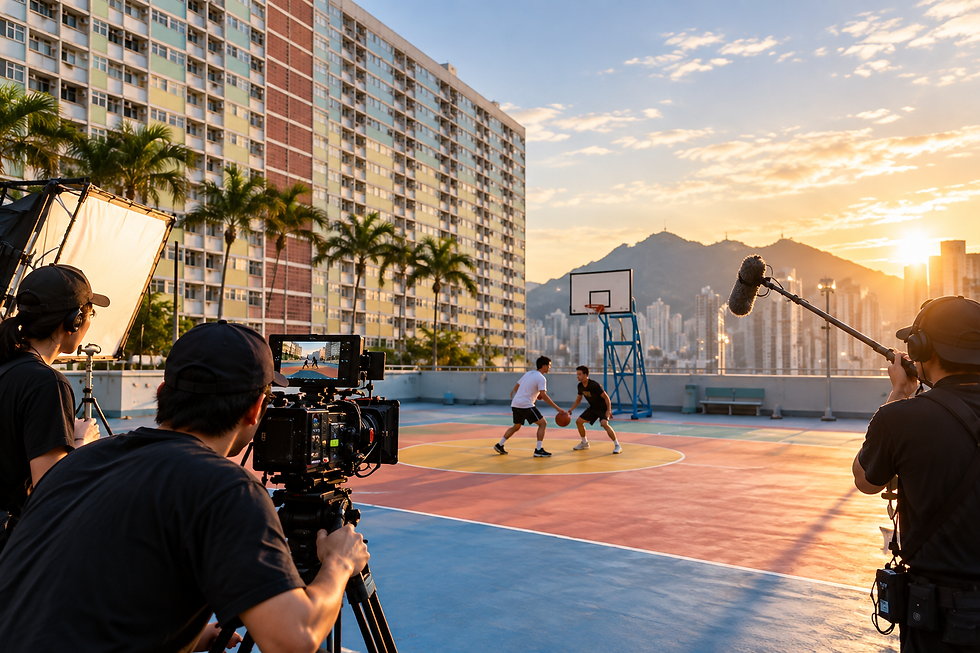
The rainbow blocks and the rooftop basketball court are still there. They won't be for long. The Housing Authority's redevelopment plan puts first-phase demolition around 2028 to 2029, with the full site rebuilt by the late 2040s.
It's a public housing estate, so filming needs departmental permission rather than a cheerful walk-up. Worth the paperwork. Any campaign or documentary about a changing Hong Kong has maybe two more years to capture this honestly.
Kai Tak: the location that didn't exist three years ago
Kai Tak Sports Park opened on 1 March 2025 and pulled over seven million visitors in its first ten months. A 50,000-seat stadium with a retractable roof, a 700-metre central avenue, and harbour-facing open space on the old airport runway.
For any client in sport, energy drinks, telco or automotive, this is the one location in the city with no visual history attached. Nobody has overshot it yet.

Tsim Sha Tsui waterfront and Victoria Harbour
The skyline reverse is the shot clients ask for by name. The promenade is LCSD-managed, so it needs permission, and it gets genuinely crowded after 5pm.
Better option: shoot from the water. A junk or a hired vessel gives you a moving platform, a clean 180 degrees of skyline, and none of the crowd control problems. Filming within Hong Kong waters needs government clearance, so factor that in early.
Sai Kung, Tai O and the outlying islands
This is the part visiting producers never budget for. Roughly 40% of Hong Kong is country park. Sai Kung's beaches, the hiking trails on Lantau, the stilt houses of Tai O fishing village, the ferries out to Cheung Chau.
For documentary production in Asia especially, Tai O gives you something the skyline cannot: faces, trade, texture, a working community. Country parks need permission from the relevant department, and the travel time is real, so don't schedule a Central morning and a Tai O afternoon on the same day.

Schedule around the weather, not the locations
Typhoon season runs roughly from May to November. A T8 signal stops everything, and no insurer will pretend otherwise. Summer humidity fogs glass and wrecks continuity in the wardrobe.
October through December is the window: clear air, good visibility across the harbour, comfortable temperatures for crew. January and February work too, cooler and often hazier. If you're planning video production in Hong Kong on a tight budget, shooting in the shoulder months buys you availability, but builds in a contingency day.
Where to go from here
The locations are the easy part. Sequencing them is the job, because a single shoot day in Hong Kong can move from an unpermitted public street to a private tower lobby to a government pier, each under a different authority with a different calendar.
That's the work a local crew does before anyone picks up a camera. Culture Kid Films has been producing commercials, branded content and television production across Asia for over a decade from our Hong Kong and Sydney bases. As a video agency in Hong Kong with relationships already built at the location level, we know which building managers answer, which permits genuinely take ten days, and which famous location will waste your afternoon.
Send us your brief and we'll tell you what's realistic before you lock the schedule.
Frequently asked questions
Do I need a permit for filming in Hong Kong?
Not a general one. Hong Kong has no general-purpose filming permit. Filming in public areas on a non-exclusive basis requires no permit, though crews are encouraged to notify the Police Public Relations Wing for free. Government land, private venues, drones, props money and special effects each need their own separate approval.
How far in advance should I apply for a Hong Kong filming location?
Private venues take 7 to 10 working days. LCSD sports facilities can be booked from 11 days up to 3 months ahead. Government departments vary. For a multi-location commercial, start clearances at least four to six weeks out.
Can I fly a drone for commercial filming in Hong Kong?
Yes, under the Small Unmanned Aircraft Order. Drones over 250g need registration through the Civil Aviation Department's eSUA portal, which takes about 7 to 14 days. Commercial and higher-risk operations need additional permission, and the urban no-fly map changes with events and VIP movements.
What's the best time of year to shoot in Hong Kong?
October to December. Clear skies, low humidity, and reliable harbour visibility. Avoid peak typhoon season from July to September unless your schedule has contingency days built in.
Do I need work visas for a foreign crew?
Usually yes, depending on the nature of the activity. Employment visa processing takes about four weeks. Equipment itself enters duty-free, and ATA Carnets should be endorsed by Customs on arrival and before departure.


Comments